yo... i had heard of and listened to some Roky Erikson before my time in Fort Worth but Fraf was shocked that I was not a Roky Erikson fan.
now it's my turn to spread the gospel
Thursday, December 11, 2008

the Bend part ii

Cruising along at the blistering park speed limit of 45 mph is a refreshing change from the inordinate 80 mph limits south of Midland/Odessa. The air is quick with creosote. Clean. Organic. Approximately 5 miles south of the ranger station, east of the road, I clearly see a titanic crack in the distant mountain shelf. As if produced by the edge of Jimi Hendrix’s legendary hand, Dog Canyon dramatically divides the Dead Horse Mountains from the Santiago Mountains. Santiago to the north, Dead Horse to the south. This bold feature is merely a clue to the scale of the natural beauty to come.

Far ahead, through 20 miles of gangly ocotillo and silver lechuguilla stalks, the mighty Chisos Mountains bestir in the morning blue, yet frozen in their ancient volcanic attempt to escape the blond landscape around them. Escape to where? I wonder. The entire Chisos range resides in the park. Each peak is unique and shares few characteristics with his siblings aside from color and texture. These hills and peaks will be my home for the next two weeks.

Panther Junction, technically an HQ and visitor center, is a larger station than Persimmon Gap. There’s a bookstore, a post office, a gas station and a restricted cluster of residential structures, housing for park employees. I make a quick lap through the parking lot. Tourists flutter and stumble about the place like a flock of idiotic birds, a somewhat repulsive gathering of elastic waist bands and White Diamonds. Driving farther south, I search for my escape from the immaculate paint and paving of Highway 385. My escape is called Glenn Springs Road, the beginning of many miles of rough backcountry roads cutting through the heart of the wilderness.

My destination is a primitive campsite called Rice Tank, named for the adjacent earthen water catch built by the Rice family roughly ninety years ago to feed cattle. The road is one lane with periodic shoots of grating curling away in short limbs, convenient for yielding to other 4x4 behemoths. When two vehicles meet, rumbling in opposite directions, a strange telepathic communication ensues, usually culminating in a squeezing yield by the larger of the two machines. These roads are barely maintained by the park service, gravel pooling in the lower ruts, dangerous terraced slabs of unearthed rock, craters. I would hope the lack of maintenance is to discourage traffic but I suspect laziness.

I’ve never seen the Chisos from the east but once I bring my Ford Ranger in a cloud of gravelly dust to the peak of a hill just south of Nugent Mountain (the Nuge!) their primordial splendor is enough to make me crunch to a halt, mouth gaping in awe. The peaks are crowned with fleshy, red crumbling rock not unlike cubes and slabs of raw pork. I see the square jawed faces of a thousand antediluvian robots in as many stripes of stone. The foothills are heavily blond, splattered with greens of every shade and variant. There is another color. It’s not gray. It’s black. A black that knows its place, fully aware of its power and plays when the time is right. Gray lives in the land I abandoned to come here. The High Plains. Gray broods there like a troll.
The Bend part i
10 miles north of Odessa/Midland: This land stinks of foul seepage. Mantis shaped oil pumps pepper the flat landscape doing what mantises do: they sit and they wait for a reason to move. Frozen in black silence. I give myself a giggle as the terrain reminds me of landscape intensive video games: yellow grass, yellow grass, white tank-blue tank-white tank, yellow grass, telephone poll, yellow grass, white tank-blue tank-white tank... repeat as needed...
Midland/Odessa is a lost Dallas suburb that has strayed beyond the point of no return. It's as if Dallas, in some fit of fleeting disgust drove to the country and shoved this unwanted household pet from the open door of a creeping sedan. And so, after whining and howling with loneliness, Midland/Odessa ("Home of President and Laura Bush!") finally composed itself and commenced to sprawling: 35 mph freeways, excruciating numbers of numbered loops, groves of trees that don't belong and will never will, black exhaust of hundreds of thousands of trucks, Arby's, Cheddar's, Applebee's, McDonalds, TGIFridays, Arby's, Cheddar's, Applebee's, McDonalds, TGIFridays … repeat as needed…
Monahans: Lovely little town. Lovely little truck-stop sign "WE HAVE EPHEDRINE." Another sign that catches my attention "STUDIES SHOW THAT PEOPLE WITH FAITH LIVE LONGER." Ahhh, the balance of the world is eternal. In all of the choices we make, the universe is always there to set the scales flush. Yes, you gain a bit from faith. I gain from other things, say marijuana, for example. And I lose a thing too… don't remember what it is… I had it right on the tip of my tongue…oh well. Back to balance. Yes, those who have an abundance of faith seem to gain a few years but they certainly run the risk of being assholes for the duration.
After Monahans, through Grandfalls and Fort Stockton the landscape goes to twisting and morphing. Here rise the first of many desert mountains to come. Long stretches of high mesa shimmer in the sliding sun. Gazing southwest, I can see for probably 50 miles across the valley between Wolf Camp Hills and the Sugar Loaf and Spencer Mountains. I can just barely catch a glimpse of Cathedral Mountain far to the west, over a spine of rocky peaks. The spirit of this land swells. Lands do have spirits, more so than people. I've yet to meet a person who conveys other world sentiments as well as landscape. Once past Marathon (pronounced locally with a lazy "thun" instead of the Greek "thon") the land troughs visibly on a massive scale. Everything rolls downhill. Here downhill is Mexico, channeled through the super-sized national park to the south.
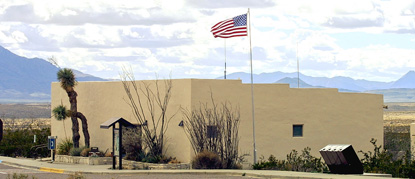
I reach the empty Persimmon Gap Ranger Station at approximately 6:15. The sun is drowsy. I sleep in a picnic area under a bent NO CAMPING sign. That night I dream that the National Park Service requires a vehicle title for entrance. Nightmare.

Pre-dawn greets me, groggy and stretching in the bed of my truck, with a salmon glow over the Klippe Peak to the east, its silhouette laced with a penumbra of fire. I percolate coffee on a single-burner propane stove given to me by my friend Cadillac Fraf before his accident. I think of him and his family for a moment, somewhat guilty that I'm here and they are there in that unfortunate situation. "Wake up, Fraf," I say as the first solid ray of galactic light beams across the fading indigo of dawn.
Twenty dollars for the vehicle permit, good for seven days, and ten dollars for the backcountry camping permit, good for up fourteen days, all sold to me by a softly featured female ranger named Alice. Alice is married, the evidence on her finger, but her eyes shine in defiance. Sorry, Alice, the last thing I need first thing this morning is you and whatever shape, size and temperament of your husband, asleep and no doubt hungover in the trailer out back.
(more to come… I hate editing…)
Midland/Odessa is a lost Dallas suburb that has strayed beyond the point of no return. It's as if Dallas, in some fit of fleeting disgust drove to the country and shoved this unwanted household pet from the open door of a creeping sedan. And so, after whining and howling with loneliness, Midland/Odessa ("Home of President and Laura Bush!") finally composed itself and commenced to sprawling: 35 mph freeways, excruciating numbers of numbered loops, groves of trees that don't belong and will never will, black exhaust of hundreds of thousands of trucks, Arby's, Cheddar's, Applebee's, McDonalds, TGIFridays, Arby's, Cheddar's, Applebee's, McDonalds, TGIFridays … repeat as needed…
Monahans: Lovely little town. Lovely little truck-stop sign "WE HAVE EPHEDRINE." Another sign that catches my attention "STUDIES SHOW THAT PEOPLE WITH FAITH LIVE LONGER." Ahhh, the balance of the world is eternal. In all of the choices we make, the universe is always there to set the scales flush. Yes, you gain a bit from faith. I gain from other things, say marijuana, for example. And I lose a thing too… don't remember what it is… I had it right on the tip of my tongue…oh well. Back to balance. Yes, those who have an abundance of faith seem to gain a few years but they certainly run the risk of being assholes for the duration.
After Monahans, through Grandfalls and Fort Stockton the landscape goes to twisting and morphing. Here rise the first of many desert mountains to come. Long stretches of high mesa shimmer in the sliding sun. Gazing southwest, I can see for probably 50 miles across the valley between Wolf Camp Hills and the Sugar Loaf and Spencer Mountains. I can just barely catch a glimpse of Cathedral Mountain far to the west, over a spine of rocky peaks. The spirit of this land swells. Lands do have spirits, more so than people. I've yet to meet a person who conveys other world sentiments as well as landscape. Once past Marathon (pronounced locally with a lazy "thun" instead of the Greek "thon") the land troughs visibly on a massive scale. Everything rolls downhill. Here downhill is Mexico, channeled through the super-sized national park to the south.
I reach the empty Persimmon Gap Ranger Station at approximately 6:15. The sun is drowsy. I sleep in a picnic area under a bent NO CAMPING sign. That night I dream that the National Park Service requires a vehicle title for entrance. Nightmare.
Pre-dawn greets me, groggy and stretching in the bed of my truck, with a salmon glow over the Klippe Peak to the east, its silhouette laced with a penumbra of fire. I percolate coffee on a single-burner propane stove given to me by my friend Cadillac Fraf before his accident. I think of him and his family for a moment, somewhat guilty that I'm here and they are there in that unfortunate situation. "Wake up, Fraf," I say as the first solid ray of galactic light beams across the fading indigo of dawn.
Twenty dollars for the vehicle permit, good for seven days, and ten dollars for the backcountry camping permit, good for up fourteen days, all sold to me by a softly featured female ranger named Alice. Alice is married, the evidence on her finger, but her eyes shine in defiance. Sorry, Alice, the last thing I need first thing this morning is you and whatever shape, size and temperament of your husband, asleep and no doubt hungover in the trailer out back.
(more to come… I hate editing…)
last time. i promise.
"Language is the process that lashes experience to intellect."
-Robert Stone in Prime Green
-Robert Stone in Prime Green
...don't tell me. i fully aware...
..that i'm kind of addicted to Robert Stone:
"The color of her eyes was nearly Viking blue, but with a Celtic shadow." - from Outerbridge Reach
holy shit this guy....
"The color of her eyes was nearly Viking blue, but with a Celtic shadow." - from Outerbridge Reach
holy shit this guy....
3 books, 2 authors
Again with some books…
I have a habit of reading many books by certain authors back to back. I did not expect unknown territory when I decided to re-read Desert Solitaire by Edward Abbey nor did I expect to be surprised by his early novel the Brave Cowboy. Also not expecting anything new, just a familiar voice telling a solid story, I read Robert Stone's late '90s novel Damascus Gate. Both Abbey (my favorite all-around author) and Stone (my favorite living author) have left me in awe. These are three stunning reads.
Perhaps youth clouded my first pouring through Desert Solitaire. It is hard to say. I do remember Abbey's virtuosic ability to describe the natural world. In fact his radiant descriptions of desert mountains, fauna, skies, and wildlife sent me in a frantic search for more of his writing. I certainly recall how I delighted in his cantankerous hatred for man's encroachment upon the wild. Admittedly, many of his cultural references were beyond my realm of intellectual knowledge but you can be guaranteed that I researched and absorbed even the most obscure. I suspect since I am now older, worldlier, closer to Abbey's intellectual level this memoir delivered a heavier impact on this second reading almost fifteen years after my first. This book isn't merely the ultimate in nature writing--light years beyond much of Thoreau's work--it forever changed the genre. When published in 1968, Desert Solitaire contemporaries were dipped in caramelized flowery, ethereal, hippy-dippy language about babbling brooks and glittering stars. Abbey shattered this style like a dried piece of juniper with his foul mouth, anarchic tirades and penchant for subversive ideology. When one reaches the end of Solitaire, conflicting emotions linger. Anger at our nation's rapacious appetite for a god-like, and still irredeemable power over Nature; elation over the fact that anyone can still wander into the wild and discover god as Abbey found him. Absent. Absent in the face of an unending, beautiful, indifferent universe. I am going to Big Bend National Park after my Mambo's gig to find my own absence of gods, men, women, machines, and societal bullshit. Praise be to you, Ed Abbey.
What else could follow a classic Edward Abbey memoir of life in the desert but an Edward Abbey novel about the stupidity of modern culture and its effects on those who will sacrifice all for freedom, the Brave Cowboy. Again, believe me when I say I picked up the Brave Cowboy mainly out of safety. I know Abbey. A familiar voice. I admit I have not read all of Abbey's writings (close but not yet all) and I am aware most critics and fans consider Desert Solitaire his best work and I am fully aware Abbey felt Black Sun his personal best and I, until reading Cowboy, an earlier novel written 12 years before the release of Solitaire, could not put any of his writings above A Fool's Progress, his last novel. But ladies and gentlemen this book is astounding. The Brave Cowboy is a simple escape/chase plot wrapped around a screaming endorsement of anarchy as less of a political ideal than a personal reality. Jack Burns is a young, lanky transient cowboy who refuses to travel on anything but a horse. Burns discovers that his best friend, one Paul Bondi, has been arrested for refusing to register for Selective Service. This is 1956, folks. A decade before crowds of unbathed counterculturalists waved flaming draft cards in the streets. Abbey had a knack for seeing and speaking out against issues long before his peers. There's your plot but most of the beauty in this book lies in Abbey's immaculate dialogue and staging, however one lone aspect of this novel stands out like a strobe for me. Optimism. In most of his writing, Edward Abbey rarely exudes any sustained optimism. Abbey's bitterness is considered by many critics to be a crutch. But up until the very end of this story--and I do mean the very end--he fills Jack Burns with the unending conviction that if one simply sticks to his principles, all will be right with the world, good may not triumph over evil but balance will be held. A Fools Progress and the Brave Cowboy are now tied for first place in my best-of-Abbey-list. This novel should be required reading for all adults between the ages of 18 and 25 as for anyone who is sick of the state of our modernized, mechanized, paved and Rustoleum lathered world.
Okay. I've spewed my love for Ed Abbey nearly to a fault. Time to do the same for Robert Stone. After reading the monster that is Damascus Gate, admiration for Stone comes easily. During the course of this book, Stone, whose talent for shedding brutal light on modern civilization has made him one of America's most critically acclaimed authors, tackles the entire city of Jerusalem, nearly every conceivable religion, the subtleties of Middle-Eastern race relations, the role of journalism in a place where the truth is as relative as favorite colors, national loyalty, terrorism, love, sex, faith and the search for it. There's actually more but I'm sure you've grown bored with that list. The sheer audacity and sweeping plot of Damascus Gate are enough the send most readers reeling, groping for the latest installment of Where's Waldo for cerebral relief. Yet if you've ever read Robert Stone, you know that he can handle the load and make it a surprisingly brisk ride. Stone's Jerusalem is a web of character after character, each tethered tenuously to an ever growing plot to blow-up the Temple on the Mount. Christopher Lucas is a journalist who, depending on present company, waffles back and forth between his patchwork catholic and Jewish heritage all the while wrestling with his complete lack of faith. When he falls in love with Sonia, a mulatto whose over abundance of faith drags her into a boiling intrigue of secret police and burgeoning cults, Lucas confronts his lack of faith silhouetted against a Holy City overpopulated with fanatics, soldiers, and thousands of people bent on rioting in the streets. Stone's language is a dream of poetry and prose. No living writer has his ability to make death so beautiful, blood so tasty, love so heartbreaking, or the chase so fast and vivid. The volume of Stone's research for this book is unfathomable. His grasp of the region and the people and the emotions sprung from within that crucible is tactile. You can smell the burning tires, feel the grit of desert sand and taste the salt of tears both joyful and sad. In Damascus Gate's final moments, Stone reveals that true faith belongs to those who want to believe not those--like me and Stone--who have outsmarted themselves with their search for a truth that in the end requires, you guessed it, faith. Faith in their own ability to find that truth.
I have a habit of reading many books by certain authors back to back. I did not expect unknown territory when I decided to re-read Desert Solitaire by Edward Abbey nor did I expect to be surprised by his early novel the Brave Cowboy. Also not expecting anything new, just a familiar voice telling a solid story, I read Robert Stone's late '90s novel Damascus Gate. Both Abbey (my favorite all-around author) and Stone (my favorite living author) have left me in awe. These are three stunning reads.
Perhaps youth clouded my first pouring through Desert Solitaire. It is hard to say. I do remember Abbey's virtuosic ability to describe the natural world. In fact his radiant descriptions of desert mountains, fauna, skies, and wildlife sent me in a frantic search for more of his writing. I certainly recall how I delighted in his cantankerous hatred for man's encroachment upon the wild. Admittedly, many of his cultural references were beyond my realm of intellectual knowledge but you can be guaranteed that I researched and absorbed even the most obscure. I suspect since I am now older, worldlier, closer to Abbey's intellectual level this memoir delivered a heavier impact on this second reading almost fifteen years after my first. This book isn't merely the ultimate in nature writing--light years beyond much of Thoreau's work--it forever changed the genre. When published in 1968, Desert Solitaire contemporaries were dipped in caramelized flowery, ethereal, hippy-dippy language about babbling brooks and glittering stars. Abbey shattered this style like a dried piece of juniper with his foul mouth, anarchic tirades and penchant for subversive ideology. When one reaches the end of Solitaire, conflicting emotions linger. Anger at our nation's rapacious appetite for a god-like, and still irredeemable power over Nature; elation over the fact that anyone can still wander into the wild and discover god as Abbey found him. Absent. Absent in the face of an unending, beautiful, indifferent universe. I am going to Big Bend National Park after my Mambo's gig to find my own absence of gods, men, women, machines, and societal bullshit. Praise be to you, Ed Abbey.
What else could follow a classic Edward Abbey memoir of life in the desert but an Edward Abbey novel about the stupidity of modern culture and its effects on those who will sacrifice all for freedom, the Brave Cowboy. Again, believe me when I say I picked up the Brave Cowboy mainly out of safety. I know Abbey. A familiar voice. I admit I have not read all of Abbey's writings (close but not yet all) and I am aware most critics and fans consider Desert Solitaire his best work and I am fully aware Abbey felt Black Sun his personal best and I, until reading Cowboy, an earlier novel written 12 years before the release of Solitaire, could not put any of his writings above A Fool's Progress, his last novel. But ladies and gentlemen this book is astounding. The Brave Cowboy is a simple escape/chase plot wrapped around a screaming endorsement of anarchy as less of a political ideal than a personal reality. Jack Burns is a young, lanky transient cowboy who refuses to travel on anything but a horse. Burns discovers that his best friend, one Paul Bondi, has been arrested for refusing to register for Selective Service. This is 1956, folks. A decade before crowds of unbathed counterculturalists waved flaming draft cards in the streets. Abbey had a knack for seeing and speaking out against issues long before his peers. There's your plot but most of the beauty in this book lies in Abbey's immaculate dialogue and staging, however one lone aspect of this novel stands out like a strobe for me. Optimism. In most of his writing, Edward Abbey rarely exudes any sustained optimism. Abbey's bitterness is considered by many critics to be a crutch. But up until the very end of this story--and I do mean the very end--he fills Jack Burns with the unending conviction that if one simply sticks to his principles, all will be right with the world, good may not triumph over evil but balance will be held. A Fools Progress and the Brave Cowboy are now tied for first place in my best-of-Abbey-list. This novel should be required reading for all adults between the ages of 18 and 25 as for anyone who is sick of the state of our modernized, mechanized, paved and Rustoleum lathered world.
Okay. I've spewed my love for Ed Abbey nearly to a fault. Time to do the same for Robert Stone. After reading the monster that is Damascus Gate, admiration for Stone comes easily. During the course of this book, Stone, whose talent for shedding brutal light on modern civilization has made him one of America's most critically acclaimed authors, tackles the entire city of Jerusalem, nearly every conceivable religion, the subtleties of Middle-Eastern race relations, the role of journalism in a place where the truth is as relative as favorite colors, national loyalty, terrorism, love, sex, faith and the search for it. There's actually more but I'm sure you've grown bored with that list. The sheer audacity and sweeping plot of Damascus Gate are enough the send most readers reeling, groping for the latest installment of Where's Waldo for cerebral relief. Yet if you've ever read Robert Stone, you know that he can handle the load and make it a surprisingly brisk ride. Stone's Jerusalem is a web of character after character, each tethered tenuously to an ever growing plot to blow-up the Temple on the Mount. Christopher Lucas is a journalist who, depending on present company, waffles back and forth between his patchwork catholic and Jewish heritage all the while wrestling with his complete lack of faith. When he falls in love with Sonia, a mulatto whose over abundance of faith drags her into a boiling intrigue of secret police and burgeoning cults, Lucas confronts his lack of faith silhouetted against a Holy City overpopulated with fanatics, soldiers, and thousands of people bent on rioting in the streets. Stone's language is a dream of poetry and prose. No living writer has his ability to make death so beautiful, blood so tasty, love so heartbreaking, or the chase so fast and vivid. The volume of Stone's research for this book is unfathomable. His grasp of the region and the people and the emotions sprung from within that crucible is tactile. You can smell the burning tires, feel the grit of desert sand and taste the salt of tears both joyful and sad. In Damascus Gate's final moments, Stone reveals that true faith belongs to those who want to believe not those--like me and Stone--who have outsmarted themselves with their search for a truth that in the end requires, you guessed it, faith. Faith in their own ability to find that truth.
Subscribe to:
Posts (Atom)
